

AI-Summary – News For Tomorrow
New research highlights a critical flaw in asteroid deflection strategies: hitting the wrong spot could inadvertently redirect the asteroid through “gravitational keyholes,” delaying the impact instead of preventing it. These keyholes, areas where a planet’s gravity alters an asteroid’s trajectory, could send the space rock back towards Earth years or decades later. Researchers at the University of Illinois have created “probability maps” to identify the safest impact zones on an asteroid’s surface to avoid this scenario. While detailed mapping requires space missions, preliminary maps can be generated from ground-based observations for late-discovered threats. Precise planning is crucial for future planetary defense missions.
News summary provided by Gemini AI.
When a massive asteroid is hurtling toward Earth, the solution seems straightforward; smash a spacecraft into it and knock it off course.
But new research reveals the chilling possibility that an asteroid hit in the wrong spot, and you might just be postponing the impact!
Related: You’re More Likely to Die From an Asteroid Than Rabies, Scientists Find
Scientists at the University of Illinois have discovered that poorly aimed asteroid deflection attempts could accidentally steer space rocks through dangerous regions in space known as “gravitational keyholes” that would alas, still mean they hit Earth, just years or decades later!
A gravitational keyhole is a small region of space where a planet’s gravity can modify a passing asteroid’s orbit such that it returns on a collision course with that planet at a later date. Think of it like a rather funky pinball machine where hitting the wrong bumper sends the ball ricocheting back toward the flippers.
“Even if we intentionally push an asteroid away from Earth with a space mission, we must make sure it doesn’t drift into one of these keyholes afterwards. Otherwise, we’d be facing the same impact threat again down the line” – Rahil Makadia from NASA
To solve this problem, Makadia’s team has developed “probability maps” that identify the safest spots to strike each asteroid. Each point on the surface of an asteroid has a different probability of sending the asteroid through a gravitational keyhole after deflection by a kinetic impactor.

frameborder=”0″ allow=”accelerometer; autoplay; clipboard-write; encrypted-media; gyroscope; picture-in-picture; web-share” referrerpolicy=”strict-origin-when-cross-origin” allowfullscreen>
Creating these maps requires detailed knowledge of the asteroid’s characteristics such as its shape, surface features, rotation, and mass. Ideally this would be done with a space mission to rendezvous with the asteroid, producing high resolution images and data.
However, if an asteroid is discovered late with little time before impact, scientists can create preliminary, lower quality maps using ground based telescope observations alone.
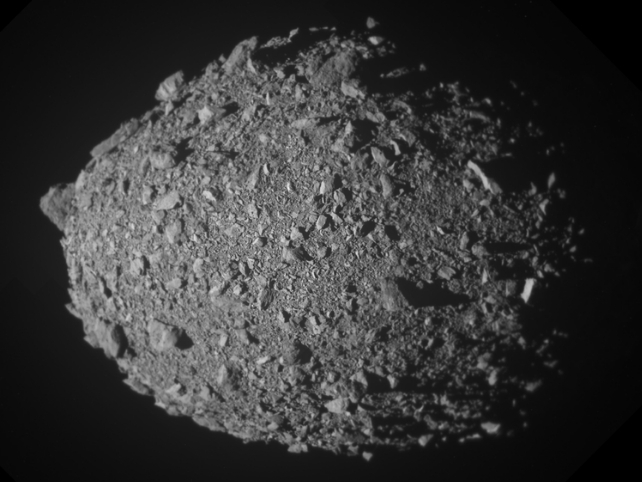
While DART’s target, Dimorphos, was chosen precisely because the Didymos system is too massive to be deflected onto a collision course with Earth, future asteroid threats won’t be so forgiving. Real planetary defence missions will require a high level of precision planning.
This article was originally published by Universe Today. Read the original article.

