
AI-Summary – News For Tomorrow
China is developing a comprehensive near-Earth asteroid defense system, encompassing monitoring, in-orbit handling, and response strategies. Since 2006, China has been surveying near-Earth objects, deploying telescopes and planning for defense systems. China actively participates in international asteroid defense organizations (IAWN and SMPAG) and is committed to sharing observation data and research through IAWN. They are also seeking international collaborations in monitoring, development, and data sharing, emphasizing that asteroid defense is a global responsibility for the security of Earth and humanity’s future.
News summary provided by Gemini AI.
*The concept covers aspects such as monitoring and early warning, in-orbit handling, and systematic response, with the goal of building a comprehensive near-Earth asteroid detection and defense system.
*Near-Earth asteroids are among the most potentially hazardous objects in the solar system. China has done a series of preparation for asteroid defense.
ASTEROID DEFENSE PROGRAM
China has done a series of preparation works for asteroid defense. In 2006, the China National Space Administration launched the near-Earth object survey program. A white paper released in 2022 detailing China’s space programs outlined plans to demonstrate and develop a near-Earth asteroid defense system.
China has also established routine sky-survey capacity. It has deployed telescopes including the 1-meter telescope at the Purple Mountain Observatory in east China, the 2.5-meter wide-field survey telescope in Lenghu in northwest China, as well as the 2.16-meter telescope in Xinglong in north China, and the 2.4-meter and 1.8-meter telescopes in Lijiang in southwest China.
INTERNATIONAL COOPERATION
In 2014, the International Asteroid Warning Network (IAWN) and the Space Mission Planning Advisory Group (SMPAG) were established under the UN framework, becoming the two major global organizations for asteroid defense. China has been an active participant in the activities of both organizations.
At this conference, global scientists highly commended China’s plan. “The theme of this conference is both timely and highly relevant,” said Driss El Hadani, deputy director of the United Nations Office for Outer Space Affairs (UNOOSA). He noted that asteroids are not only of scientific interest, but also present potential risks and opportunities for humanity.
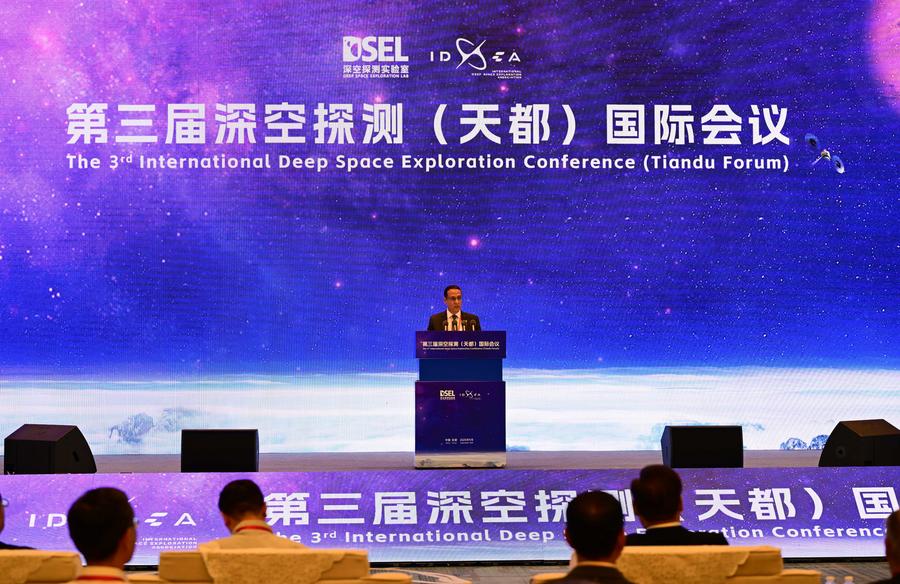
“China’s observation data and research findings will be shared with international partners through the IAWN platform,” said Wu Weiren. He welcomed global partners to actively collaborate in areas such as joint ground-based monitoring, cooperative development and payload hosting, as well as sharing of data and results.
“From the perspective of safeguarding Earth’s security and ensuring the continuity of human civilization, building asteroid defense capabilities is a shared mission for all humanity.” he added.
RESOURCE FOR HUMANITY